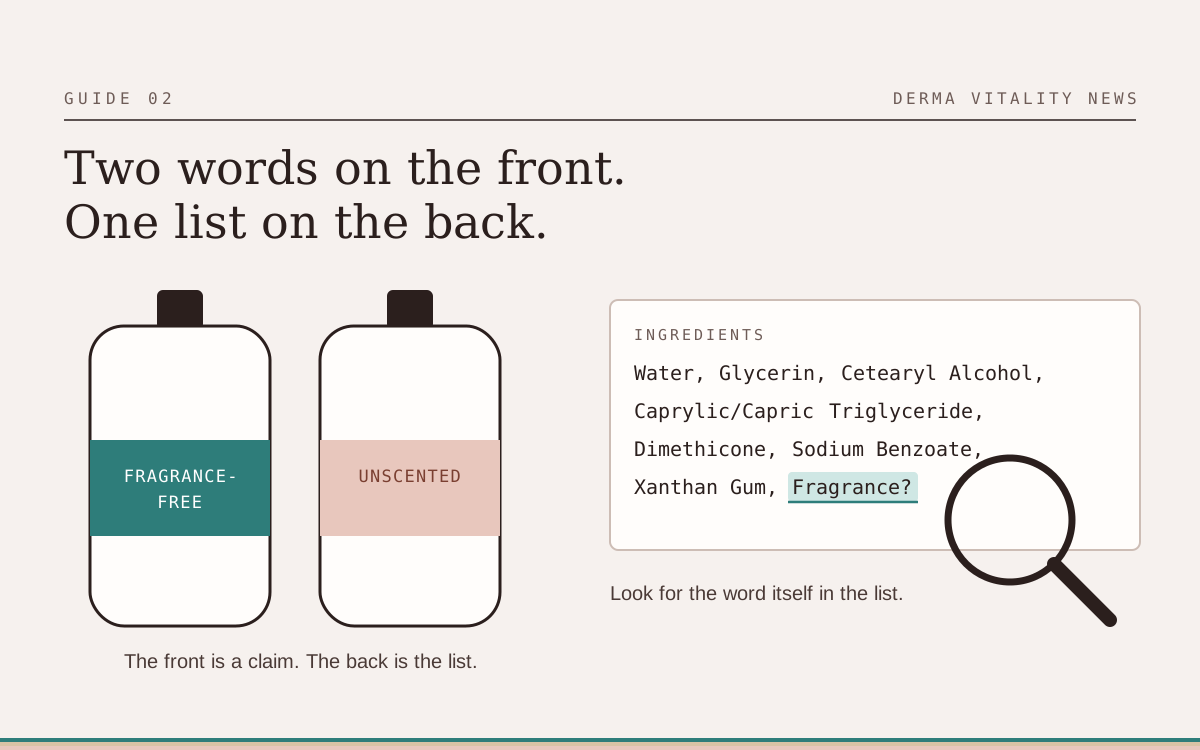
"Fragrance-free" and "unscented" are not interchangeable, and neither has a legal definition in the United States. The FDA says no federal standard or definition governs "hypoallergenic," "fragrance-free" or "for sensitive skin," and it tells shoppers that checking for those words isn't enough; read the ingredient panel instead [3]. This guide explains what the words usually signal, what the rules do require, and how to scan a list for fragrance in a few seconds.
What the two words usually signal
Since there's no federal definition, the meanings below describe how the terms are generally used and what the FDA and the American Academy of Dermatology (AAD) warn about. They don't describe any legal guarantee.
- "Fragrance-free" is generally used to mean no ingredient was added to give the product a scent. The AAD's advice for dry, easily irritated skin is to look for products labeled "fragrance-free" [6].
- "Unscented" is about what you smell, not what's in the bottle. The FDA says some products labeled "unscented" may contain fragrance ingredients, added in just the amount needed to mask the smell of other ingredients without giving the product a noticeable scent [1]. The AAD says the same, noting that such odor-masking chemicals can irritate dry, sensitive skin [6].
The FDA's labeling guide explains how a masking agent reaches the label. It may be listed under its own name or simply as "fragrance," and if it is present at an insignificant level it can count as an incidental ingredient that doesn't have to be listed at all [5]. So an "unscented" product may show the word "Fragrance" in its list, or it may show nothing.
Treat both words as the brand's claims. The ingredient list is the part of the package the FDA actually requires for retail cosmetics [3], so it's the part to check.
How fragrance appears on a US ingredient list
Under 21 CFR 701.3, a cosmetic's label lists each ingredient in descending order of predominance, except that fragrance or flavor may be listed simply as "fragrance" or "flavor" [7]. The FDA explains why: the ingredient list is required under the Fair Packaging and Labeling Act, that law can't be used to force a company to disclose formulas it protects as confidential, and fragrance blends (complex mixtures of natural and synthetic chemicals) are the kind of formula most likely to be protected [1]. One word can stand for dozens of components.
A few more rules shape what you see:
- English first. The FDA requires common or usual names and doesn't accept an EU term alone, but it doesn't object to one in parentheses after the English name, as in "Fragrance (Parfum)" [4].
- Components may be named instead. A company can list the individual components of a fragrance by their own label names rather than using the single word [5].
- "Essential oils" has no regulatory definition. The FDA says the law handles ingredients from plants the same way as ingredients from any other source [1]. A plant oil can add scent without the word "fragrance" appearing on the label.
"Hypoallergenic" is not a standard
The FDA is blunt about this term: there are no federal standards or definitions for it, it means whatever a particular company wants it to mean, and manufacturers don't have to send the FDA any evidence behind the claim [2]. The agency's historical note explains that it tried to define the term in the 1970s, and a federal appeals court struck the regulation down. The same note says there is no such thing as a cosmetic guaranteed never to cause an allergic reaction [2]. The FDA's consumer safety page repeats the point: don't assume a "hypoallergenic" product won't cause a reaction [9].
Named fragrance allergens and where the law stands
The FDA lists fragrances as one of five classes of common cosmetic allergens and reproduces the European Commission's list of 26 fragrance ingredients identified as allergens. The list includes linalool, d-limonene, citronellol, geraniol, eugenol, coumarin, citral and benzyl alcohol [3]. The FDA notes that these specific ingredients may not be identified on a US label [3]. Some US labels name them anyway, because a company may list the components of a fragrance individually instead of using the single word [5].
The Modernization of Cosmetics Regulation Act of 2022 (MoCRA) requires the FDA to establish fragrance allergen labeling regulations [8]. On September 30, 2026, the FDA's MoCRA page still listed fragrance allergen labeling among the regulations the law requires the agency to establish, and we found no final rule on that page. The FDA's fragrance page still says the agency doesn't have the same legal authority to require allergen labeling for cosmetics as for food [1]. We'll update this section if a final rule appears on the FDA's pages.
How to scan an ingredient list for fragrance
This takes under a minute and works on any cosmetic with a US ingredient list.
Find the full list 10 sec
On the carton, bottle or a firmly attached tag, tape or card [7]. For online orders the FDA allows the ingredient declaration to be somewhere the package tells you how to find, such as a catalog, which the FDA currently reads as including a website [4]. If a listing shows only "key ingredients," you haven't seen the list yet.
Look for the umbrella words 10 sec
"Fragrance," "Parfum," "Flavor" or "Aroma," anywhere in the list. Where the word sits in the list doesn't change the answer: if it's there, a fragrance blend is in the formula.
Look for named fragrance components 15 sec
Scan for names from the FDA's reproduced list of 26, especially linalool, limonene, citronellol, geraniol, eugenol and coumarin [3]. Seeing one usually means a scent ingredient, or a plant oil that contains it, is in the formula, whatever the front of the pack says.
Check plant oils and extracts 15 sec
The AAD cautions that products labeled "unscented," or containing plant-based botanical ingredients, may still contain fragrance-related ingredients [10]. Essential oils often appear under Latin botanical names followed by "Oil."
Ask the manufacturer if you're unsure
The FDA suggests contacting the manufacturer named on the label if the ingredient panel still leaves questions [3].
A worked example, and one trap
Here is the ingredient list The Ordinary prints on its US product page for Niacinamide 10% + Zinc 1% (read Sep 30, 2026; the brand notes the box may differ by time and region of purchase) [11]:
Aqua (Water), Niacinamide, Pentylene Glycol, Zinc PCA, Dimethyl Isosorbide, Tamarindus Indica Seed Gum, Xanthan Gum, Isoceteth-20, Ethoxydiglycol, Phenoxyethanol, Chlorphenesin.
Marked = discussed below11 ingredients listed
Steps 2 to 4 come up empty: no "Fragrance" or "Parfum," none of the 26 named allergens, no plant oil. The trap is the marked ingredient. The European Commission's CosIng database lists three functions for ethoxydiglycol: humectant, solvent and perfuming [12]. A "perfuming" entry in a database means the substance can serve that role in some formulas; it doesn't mean it was added for scent here, and it isn't the same as the word "Fragrance" on the label. Use the umbrella words and the named allergens for the scan, and treat database function lists as background.
For a closer walk-through of order, names and the 1 percent rule, see our guide to reading an ingredient list.
If you think a product caused a reaction, stop using it. The FDA suggests calling your healthcare provider and reporting the problem to the FDA [9]. The FDA lists facial swelling and wheezing among possible allergic reactions, and says to seek medical attention immediately if signs of anaphylaxis, a severe reaction, appear, such as shortness of breath or trouble swallowing [3]. A dermatologist can arrange clinical patch testing to find which ingredient is involved; reading labels can't do that. This guide explains label wording and isn't medical advice.
Sources
- U.S. Food and Drug Administration. Fragrances in cosmetics: "unscented" products, essential oils, and why fragrance may be listed as one word. Accessed Sep 30, 2026. link
- U.S. Food and Drug Administration. "Hypoallergenic" cosmetics, with historical background on the court decision. Accessed Sep 30, 2026. link
- U.S. Food and Drug Administration. Allergens in cosmetics: common allergen classes, the 26 EU-listed fragrance allergens, and what consumers can do. Accessed Sep 30, 2026. link
- U.S. Food and Drug Administration. Cosmetic ingredient names, EU terms in parentheses, and mail-order ingredient declarations. Accessed Sep 30, 2026. link
- U.S. Food and Drug Administration. Cosmetics labeling guide (fragrance, flavor and masking agents; incidental ingredients). Accessed Sep 30, 2026. link
- American Academy of Dermatology. Dermatologists' tips for dry skin, including "fragrance-free" vs. "unscented." Accessed Sep 30, 2026. link
- Electronic Code of Federal Regulations. 21 CFR 701.3, designation of ingredients on cosmetic labels. Accessed Sep 30, 2026. link
- U.S. Food and Drug Administration. Modernization of Cosmetics Regulation Act of 2022 (MoCRA) overview page. Accessed Sep 30, 2026. link
- U.S. Food and Drug Administration. Using cosmetics safely: label terms and how to report a problem. Accessed Sep 30, 2026. link
- American Academy of Dermatology. How to test skin care products at home (last updated Aug 10, 2021). Accessed Sep 30, 2026. link
- The Ordinary. Niacinamide 10% + Zinc 1% product page, ingredient list. Accessed Sep 30, 2026. link
- European Commission. CosIng, the EU database of cosmetic ingredients (entry for ethoxydiglycol). Accessed Sep 30, 2026. link
This guide is educational and is not medical advice. Ask a dermatologist, pharmacist or other clinician about anything specific to your skin, especially if a product irritates it or you use prescription skin products.