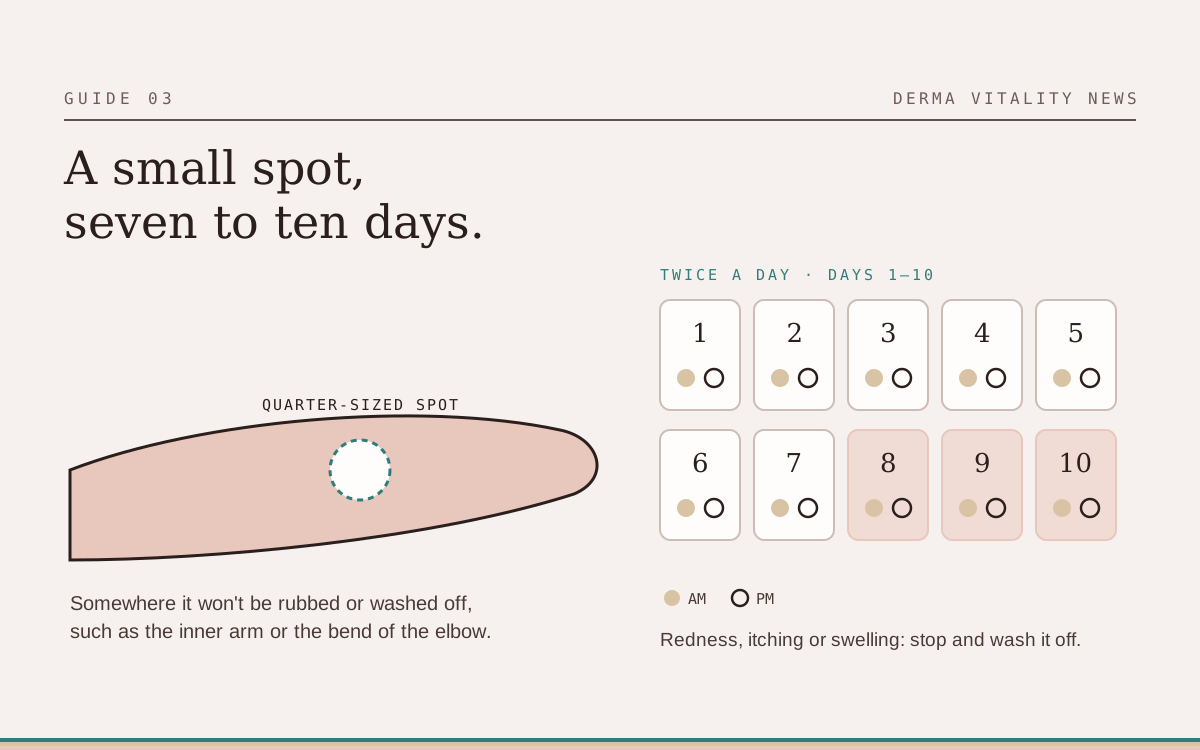
A home patch test means putting a new product on a small, out-of-the-way patch of skin, twice a day for seven to ten days, before it goes anywhere else. The American Academy of Dermatology (AAD) recommends testing a product this way before adding it to your routine, because even a product chosen carefully for your skin can turn out to irritate it; an ingredient such as a preservative can set off an allergic skin reaction in some people [1]. This guide turns the AAD's advice into a schedule you can follow.
Before you start
A few minutes of setup makes the result easier to read.
- One new product at a time. If two new products go on the same week and something reacts, you won't know which one did it. The AAD notes that pinning down the cause of irritation is often easier said than done [1].
- Read the whole label first. The FDA's first safety tip for any cosmetic is to read the label, follow all directions and heed all warnings [2]. Some products, such as certain hair dyes, come with their own test instructions [3]; if yours does, follow them.
- Scan the ingredient list for anything you already know you react to. The FDA says knowing what you're sensitive to and avoiding it is the best protection, and reading the ingredient panel is one way to do that [3].
- Wash your hands before you use the product [2], and write the date on the container.
- Keep your other products the same for the test period, so a new reaction points to the new product.
A home test checks the whole product on your skin under normal use. It doesn't tell you which ingredient is responsible if something reacts, and a clean result doesn't guarantee the product will never bother you. It lowers the odds of a surprise on your face.
The test, step by step
This follows the AAD's at-home method [1]. Use the amount and thickness you would normally use.
Pick the test spot Day 1
Choose a quarter-sized area where the product won't be rubbed or washed away, such as the underside of your arm or the bend of your elbow [1]. Use the same spot for the whole test.
Apply it the way you'd really use it Day 1
Leave-on products (serums, moisturizers, sunscreens) stay on as long as they normally would. For a rinse-off product such as a cleanser, the AAD says to leave it on for five minutes, or as long as the instructions say, before rinsing [1].
Repeat twice a day Days 1–10
Morning and evening, same spot, same amount, for seven to ten days [1]. One clean day isn't a result; the AAD's window is the full seven to ten days.
Look at the spot each time Days 1–10
Before each application, check for redness, itching or swelling, the reactions the AAD names [1]. A short note on your phone (date, time, what you saw) is enough.
Decide Day 7–10
If there has been no reaction after seven to ten days, the AAD says to go ahead and use the product [1]. Add it to your routine as its label directs, and give the next new product its own test.
How each routine layer fits the test
The method is the same for every layer; what changes is how long the product stays on the test spot. These notes apply the AAD's two rules (use it as you normally would; rinse-off products stay on five minutes or as the instructions say) to this site's four layers [1].
- 01 Cleanse. A rinse-off product: lather or spread your usual amount on the spot, wait five minutes (or the time the label gives), then rinse the way you would at the sink. A cleanser whose label says it can be wiped off instead of rinsed can be tested the way you plan to use it.
- 02 Treat. Serums are leave-on. Use the few drops the label calls for on the quarter-sized spot and leave them. If the label says to use it once a day, not twice, follow the label rather than the twice-daily schedule.
- 03 Moisturize. Leave-on. Apply the thickness you'd use on your face. For a body lotion you plan to use everywhere, the elbow bend is a good spot because it's easy to leave alone.
- 04 Protect. Sunscreen is an OTC drug with its own warnings: every sunscreen's Drug Facts panel says to stop use and ask a doctor if a rash occurs [5]. Test the exact product and SPF you plan to buy; a brand's other sunscreens can differ in their active ingredients.
What to record, in one line per check: the date and time, the product's full name and size, the spot you used, and what you saw (nothing, redness, itching, swelling). If you ever need to talk to a clinician about a reaction, that line and the container's ingredient list are the two most useful things you can bring.
Reading the result honestly
Not every sensation counts as a failed test. The AAD notes that some ingredients, and it names retinol and glycolic acid, can irritate skin, particularly sensitive skin, and describes that as normal and temporary [1]. A product's own label may also describe expected tingling or directions for building up use; follow it.
What the AAD counts as a reaction is red, itchy or swollen skin at the test spot [1]. The FDA lists a wider range of possible allergic reactions to cosmetics, including itchy skin, a rash, flaking or peeling skin and facial swelling [3]. If you can't tell whether what you're seeing is expected irritation or a reaction, treat it as a reaction and stop.
If the test spot reacts
These steps combine the AAD's home advice with the FDA's reporting advice.
Wash it off
Gently wash the product off as soon as possible, and don't use it again [1].
Calm the spot
The AAD suggests a cool compress or petroleum jelly if needed [1].
Get help if it's severe or persists
If the reaction is severe or doesn't settle with cool compresses or petroleum jelly, the AAD says you may need to see a dermatologist [1]. The FDA says to seek medical attention immediately if signs of anaphylaxis, a severe allergic reaction, appear, such as shortness of breath, trouble swallowing or lightheadedness [3].
Report it
The FDA asks people to stop using the product, call a healthcare provider about how to care for the problem, and report the reaction to the FDA [2]. Keep the container so you have the exact product name and ingredient list.
A home test is not a clinical patch test
The phrase "patch test" also names a medical test, and the two are easy to confuse. In the clinical version, possible allergens are taped to the skin for 48 hours and a clinician reads the area at 72 to 96 hours [4]. The FDA adds that it usually takes two to three office visits [3]. Because it tests individual substances, it can help find which ingredient is behind a reaction, something a home test can't do. The AAD suggests that if the exact cause is hard to pin down, a board-certified dermatologist can help, and that this medical patch testing may be needed [1].
Once a cause is known, the AAD's example is fragrance: choose products labeled "fragrance-free," and stay cautious with "unscented" or botanical products, which may still contain fragrance-related ingredients [1]. Our guide to fragrance-free vs. unscented explains how to check the list.
Skip the home test and ask a dermatologist or pharmacist first if you use prescription skin products, have a skin condition under care, or have had a strong reaction to a cosmetic before. Seek care right away for any sign of a severe allergic reaction [3]. This guide describes a general precaution for healthy adults; it isn't a diagnostic test and isn't medical advice.
Sources
- American Academy of Dermatology. How to test skin care products at home (last updated Aug 10, 2021). Accessed Sep 30, 2026. link
- U.S. Food and Drug Administration. Using cosmetics safely: general tips, label terms and how to report a problem. Accessed Sep 30, 2026. link
- U.S. Food and Drug Administration. Allergens in cosmetics: common allergens, symptoms of allergic reactions, and clinical allergy testing. Accessed Sep 30, 2026. link
- MedlinePlus, U.S. National Library of Medicine. Allergy testing, skin: how prick, intradermal and patch tests are performed. Accessed Sep 30, 2026. link
- Electronic Code of Federal Regulations. 21 CFR 201.327, required warnings and directions on OTC sunscreen labels. Accessed Sep 30, 2026. link
This guide is educational and is not medical advice. Ask a dermatologist, pharmacist or other clinician about anything specific to your skin, especially if a product irritates it or you use prescription skin products.