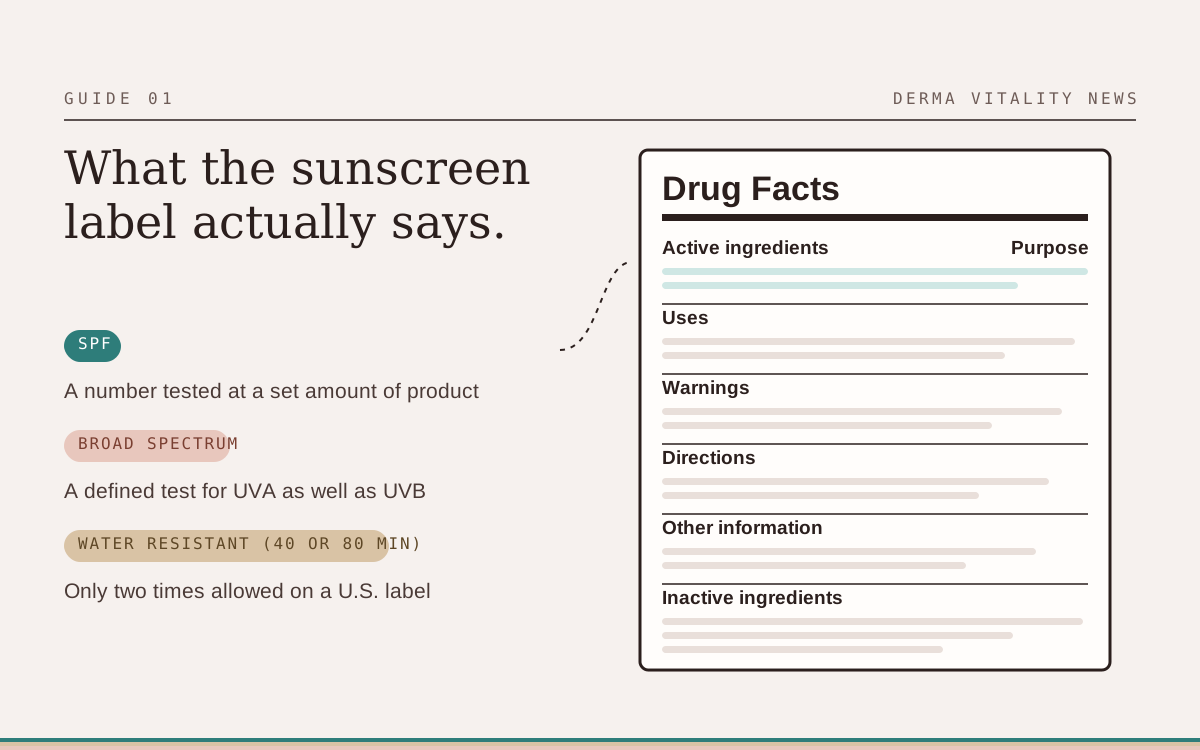
A sunscreen label is one of the most tightly scripted pieces of text in the personal-care aisle. In the United States, sunscreens are regulated as over-the-counter drugs, so the front-of-pack numbers come from defined lab tests and most of the back panel uses wording the FDA writes itself [1][2]. Once you know what the fixed phrases mean, the rest of the bottle gets much quieter.
Why a sunscreen has a Drug Facts panel
Moisturizers and cleansers are cosmetics; a product that claims to filter UV is a drug. The FDA says that, as with other nonprescription drugs, it regulates sunscreens to meet safety and effectiveness standards, and that products bought abroad may be regulated differently (some countries treat sunscreen as a cosmetic), so an imported label may not follow the rules below [1]. A face moisturizer that carries an SPF number is both a cosmetic and a drug and has to meet both sets of labeling requirements [5].
Every drug label separates active ingredients (for sunscreens, the UV filters) from inactive ingredients (everything else: water, oils, thickeners, preservatives) [1]. The FDA's consumer page lists the active ingredients used in products labeled as sunscreen, including avobenzone, homosalate, octisalate, octocrylene, oxybenzone, titanium dioxide and zinc oxide [1]. The AAD calls a product whose actives are only titanium dioxide and/or zinc oxide a "physical" or "mineral" sunscreen, one without either a "chemical" sunscreen, and one that mixes both kinds a "hybrid" [4].
The active list does change. The FDA's page, current as of September 10, 2026, says the agency added bemotrizinol as a permitted sunscreen active in June 2026, and issued a final order on September 10, 2026 removing aminobenzoic acid (PABA) and trolamine salicylate from the sunscreen monograph; the FDA adds that it is not aware of any currently marketed sunscreen containing those two [1].
The front of the bottle: three phrases with fixed meanings
The federal rule for sunscreen labeling, 21 CFR 201.327, decides what the principal display panel (the front) may say about effectiveness [2].
"SPF" and the number after it
The SPF number comes from a standardized test on human volunteers. The sunscreen is spread at 2 milligrams per square centimeter, the skin is exposed to measured doses of UV, and testers look for the smallest dose that produces perceptible redness with clearly defined borders 16 to 24 hours later, on protected and unprotected skin. The panel has to produce at least 10 valid results [2]. The SPF is the ratio of the dose needed on protected skin to the dose needed on unprotected skin, worked out for each volunteer and then combined, with a statistical adjustment, into the labeled number. Because the test is built around redness, the FDA notes that SPF mainly describes protection against UVB [1].
SPF is about the amount of UV exposure, not time. The FDA says it is wrong to read SPF 15 as "15 times longer in the sun": how much UV you get depends on the hour, the season and your latitude [1]. The AAD adds that a high-SPF product lasts on the skin exactly as long as a low-SPF one and needs the same reapplication [4].
"Broad Spectrum"
A product can print "Broad Spectrum SPF [number]" only if it passes a separate lab test that measures how evenly it absorbs across the UV range from 290 to 400 nanometers. The rule calls that measure the critical wavelength, and a mean of 370 nm or more counts as broad spectrum [2]. The words must appear as one continuous phrase, in the same font, size and color, with nothing in between. A product that fails prints only "SPF [number]" [2]. The FDA's shorthand: broad spectrum means the product helps protect against both UVA and UVB, and not every sunscreen qualifies, so look for the phrase [1].
"Water Resistant (40 minutes)" or "(80 minutes)"
Only two water-resistance claims exist, 40 minutes or 80 minutes, and each requires the SPF to be measured again after that much time in water [2]. A product that doesn't pass makes no water-resistance claim at all. The same rule lists "sunblock," "sweatproof" and "waterproof" as false or misleading claims that would misbrand the product [2]. The FDA's plain version: there is no such thing as waterproof sunscreen, because all sunscreens eventually wash off [1].
Reading the Drug Facts panel, top to bottom
The back panel always runs in the same order. Here is what to look for under each heading.
Active ingredients first line
Each UV filter with its percentage. This is where you tell a mineral product from a chemical or hybrid one, and where you check for a filter you've reacted to before.
Uses
Standard FDA wording, not the brand's copy. Every sunscreen carries the basic use statement, and a product that tested as Broad Spectrum SPF 15 or higher may add a second statement, but only in a form that ties it to using the product as directed alongside other sun protection measures [2]. If the product is not broad spectrum or is under SPF 15, look for the bold alert in Warnings instead.
Warnings
Every sunscreen says not to use it on damaged or broken skin, to keep it out of the eyes (rinse with water to remove), and to stop use and ask a doctor if a rash occurs [2]. A product that tested below SPF 15 or failed the broad-spectrum test has to open this section with a bold alert that narrows what the product has been shown to do [2][1]. If you see that alert, the product missed at least one of those two thresholds.
Directions
Apply "liberally" or "generously" 15 minutes before sun exposure; for children under 6 months, ask a doctor. A water-resistant product then says to reapply after 40 or 80 minutes of swimming or sweating, right after towel drying, and at least every 2 hours. A product that isn't water resistant says to reapply at least every 2 hours and to use a water-resistant sunscreen if swimming or sweating [2]. Broad Spectrum SPF 15+ products also list "Sun Protection Measures": limit time in the sun, especially 10 a.m. to 2 p.m., and wear long sleeves, pants, hats and sunglasses [2].
Other information
Required line: protect the product in this container from excessive heat and direct sun [2]. The FDA suggests wrapping the bottle in a towel or keeping it in the shade on long, hot days [1].
Inactive ingredients
The rest of the formula. Read it like any cosmetic ingredient list: fragrance, essential oils, alcohol and any ingredient you already know you react to will show up here.
How much to apply, and when to reapply
The label's word is "liberally." Agencies put numbers on it:
- Body: at least one ounce, about enough to fill a shot glass, for an average-sized adult covering head to toe, per the FDA; the AAD likewise calls about 1 ounce the minimum most adults need for skin not covered by clothing [1][4].
- Face: at least 1 teaspoon, about enough to cover the length of your index and middle fingers, per the AAD [4].
- Timing: on dry skin, 15 minutes before going outdoors [4][1].
- Reapplying: at least every 2 hours outdoors, and more often when swimming or sweating, following the bottle's directions [1][4].
- Commonly missed spots named by the FDA: ears, nose, lips (use an SPF lip product), back of the neck, hands, tops of the feet, along the hairline and any exposed scalp [1].
The AAD cites research showing that many people apply only 20 to 50 percent of the amount used in the SPF test, which is one reason it recommends a higher number rather than relying on a thin layer of a low one [4]. Spray formats have their own directions: the FDA says never to spray sunscreen directly onto your face, and sprays that contain flammable ingredients carry a flammability warning [1].
A one-minute check before you buy
The AAD's selection advice is three words on the label: broad spectrum, SPF 30 or higher, and water resistant [3]. After that, a short scan:
- The front says "Broad Spectrum SPF" followed by a number, written as one phrase.
- SPF 30 or higher, if you're following the AAD's recommendation [3].
- "Water Resistant (40 minutes)" or "(80 minutes)" if you'll be swimming or sweating; none of the banned words ("waterproof," "sweatproof," "sunblock").
- No bold alert at the top of Warnings.
- An expiration date. The FDA says a sunscreen without one should be treated as expired three years after purchase, and an expired product should be thrown away [1]. The AAD adds that obvious changes in color or consistency are a reason to replace it [4].
- Inactive ingredients you know you tolerate. For anything new, patch test it first.
Follow the label: stop using the product and ask a doctor if a rash occurs [2]. The FDA recommends keeping infants under six months out of the sun and asking a doctor before using sunscreen on them [1]. If you take prescription medicines or use prescription skin products, ask a pharmacist or dermatologist which sunscreen and routine fit. This guide explains label wording; it does not rate any product's performance.
Sources
- U.S. Food and Drug Administration. Consumer page on sunscreen use, SPF, broad spectrum, water resistance, expiration and active ingredients (content current as of Sep 10, 2026). Accessed Sep 30, 2026. link
- Electronic Code of Federal Regulations. 21 CFR 201.327, OTC sunscreen labeling and effectiveness testing (SPF, broad-spectrum and water-resistance tests; required label statements; false claims). Accessed Sep 30, 2026. link
- American Academy of Dermatology. Infographic on selecting a sunscreen: broad spectrum, SPF 30 or higher, water resistant. Accessed Sep 30, 2026. link
- American Academy of Dermatology. Sunscreen frequently asked questions: amount, reapplication, mineral vs. chemical actives, SPF numbers, storage (last updated Feb 11, 2025). Accessed Sep 30, 2026. link
- U.S. Food and Drug Administration. Cosmetic ingredient names, including products that are both cosmetics and drugs, such as moisturizers with SPF claims. Accessed Sep 30, 2026. link
This guide is educational and is not medical advice. Ask a dermatologist, pharmacist or other clinician about anything specific to your skin, especially if a product irritates it or you use prescription skin products.